
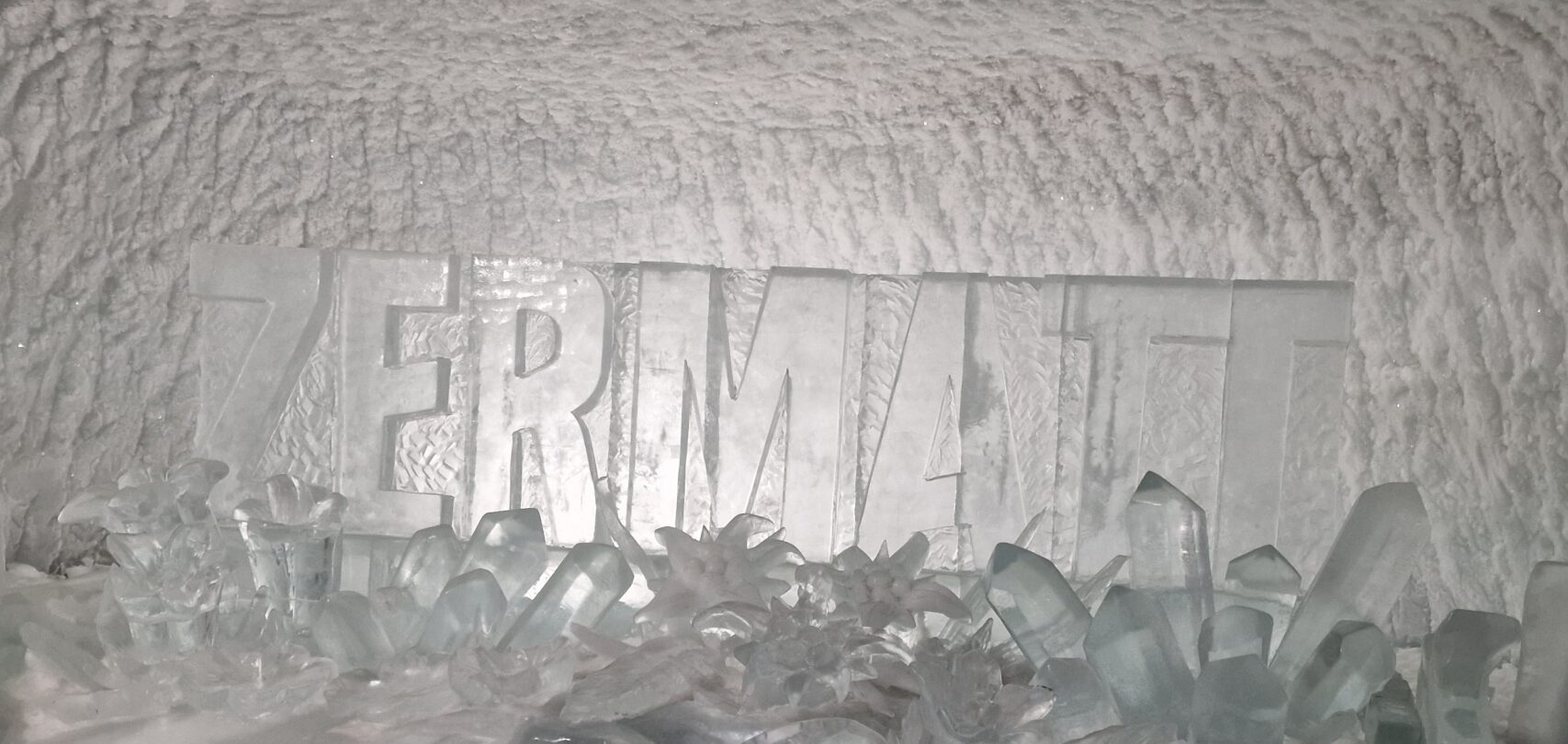
In November, I joined a study trip to Zermatt, Switzerland, with a specific destination in mind: Glacier Paradise. The goal was to visit the glacier facilities and see the ice sculptures installed inside the glacier—an experience I had been curious about for a long time. I expected something visually impressive. What I didn’t fully anticipate was how strongly the environment would shape the experience on a physical and sensory level.
Zermatt itself already feels distinct before you even go up the mountain. The village sits in a dramatic Alpine setting, framed by steep slopes and sharp ridgelines. The landscape is not just “scenic”; it is imposing. The scale of the terrain, the density of rock and snow, and the way sound carries in cold air all create a sense of heightened awareness. Even the built environment plays into this. The old wooden houses—some of them former storage huts—have a specific presence: dark timber, weathered surfaces, and compact forms that reflect practical mountain living. They add an atmosphere that is difficult to replicate elsewhere.
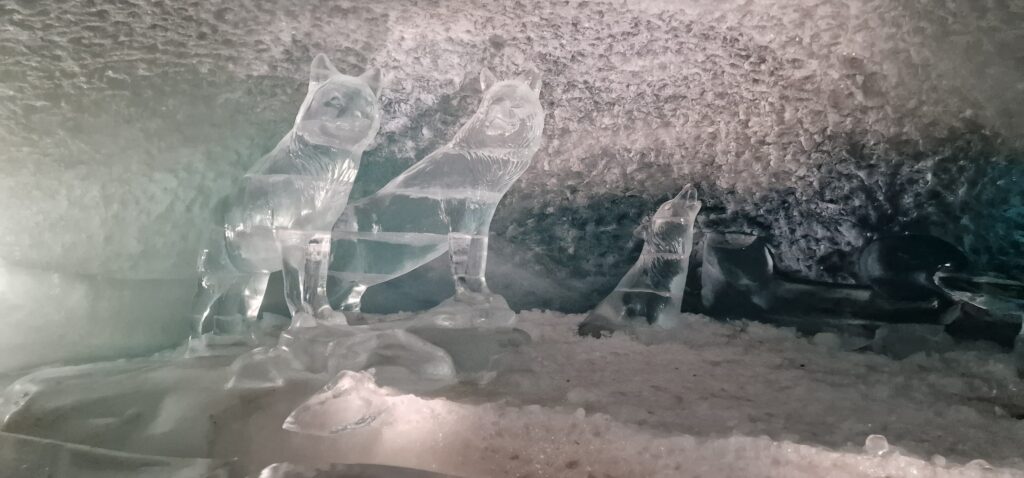
At Glacier Paradise, the main attraction for me was the concept: placing ice sculptures inside a walkable glacier. It’s a fascinating idea—art objects made of ice, kept within a naturally cold interior that is itself a geological structure.
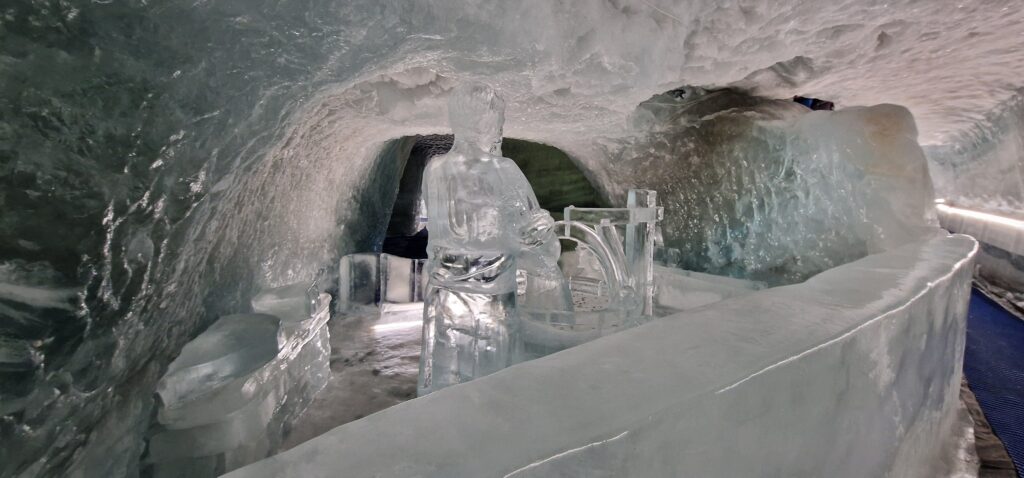
The setting changes how you perceive the sculptures. In a museum, sculpture is separated from the environment by design. Here, the “exhibition space” is part of the artwork’s material logic: temperature, humidity, dim lighting, and the subtle glow of ice. The result is visually striking, but also slightly unsettling. There is something uncanny about being underground (or effectively inside the mountain) while surrounded by carefully shaped figures that might feel decorative, symbolic, or theatrical depending on how you interpret them.
Another factor was the altitude. I live in London and spend most of my time only a few meters above sea level. In Zermatt, and especially at Glacier Paradise, the thin air was noticeable. I found it physically demanding in a way I hadn’t expected being that noticeable. But I felt my heart beating much faster and I definitely had to pace down up there in 4000m height. That physical effort became part of the overall sensory experience, and it changed how I moved through the space. I took more breaks than usual and paid more attention to small details, perhaps because everything felt slightly intensified.
At the top, I (kinda) enjoyed a green tea. Unfortunately, the viewing platform was closed due to strong winds, which was a bit disappointing, but also serves a good excuse to visit Glacier Paradise again some day.
Leaving Zermatt, I felt inspired, but also thoughtful. The place is visually powerful and culturally charged, and it raises questions: What is staged for tourism, and what is genuinely local? Are there even locals not working in tourism? How much of the “authentic atmosphere” is preserved, and how much is curated? In that sense, Zermatt is not only a destination—it’s also a productive place to reflect on cultural industry, and on what we mean when we talk about art and culture in spaces designed to be consumed.