
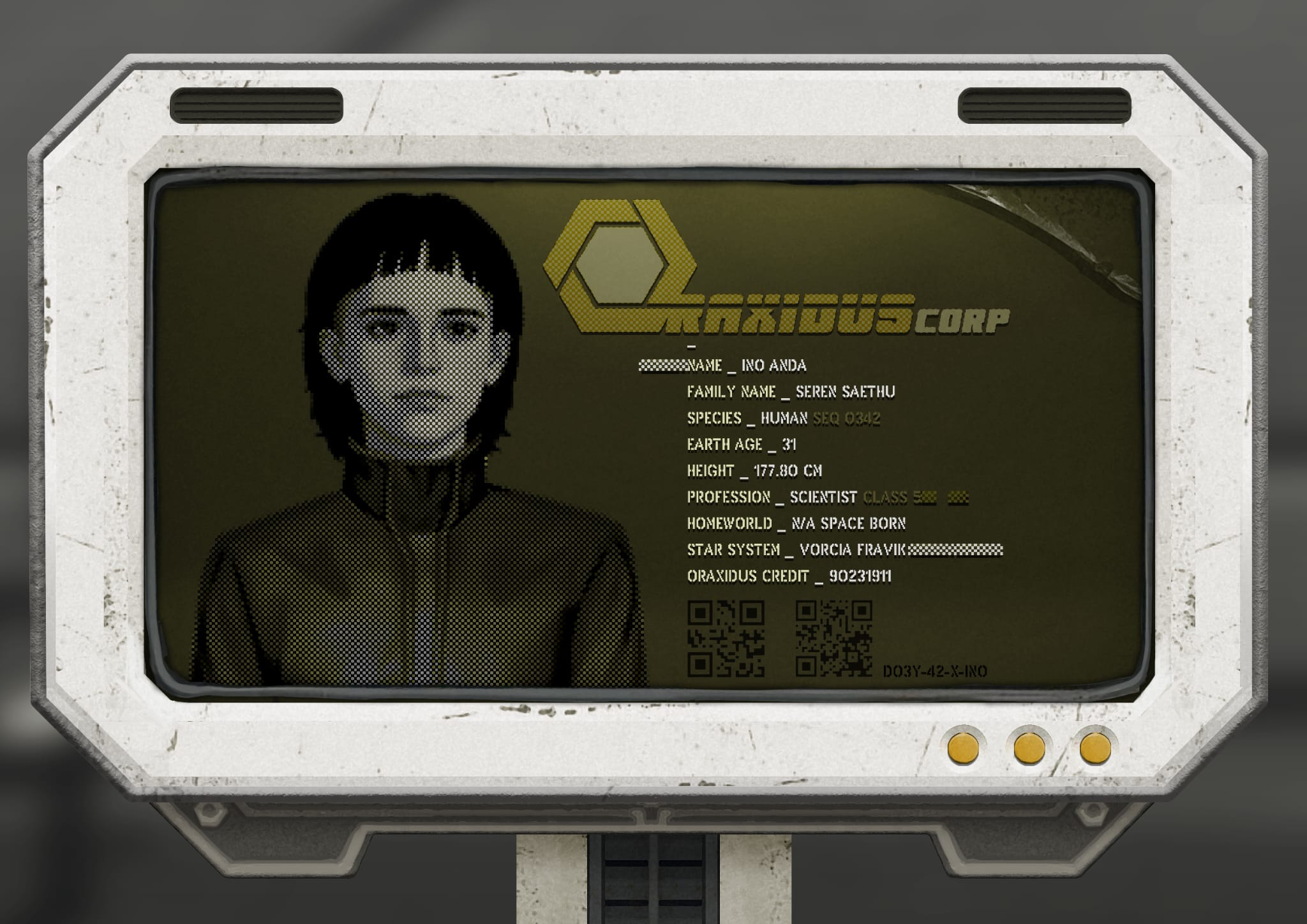
At the moment, I’m working on a space adventure game and focusing on one of its most frequently used visual systems: the interactive consoles that players will later navigate throughout the demo. These consoles are not only functional UI elements. They also serve a narrative purpose by communicating how this world records, categorices, and monitors the people living in it.
A central component of this work is a character information panel designed around the protagonist, Ino. Instead of presenting Ino with a heroic portrait or cinematic introduction, the game often frames them through the perspective of institutional interfaces—screens built to process a person as a set of attributes. The panel includes a primary display of Ino and a selection of secondary information fields such as place of birth, height, and health status, along with other administrative details. This information is deliberately presented in a structured, utilitarian manner, reflecting a system that prioritizes data clarity over individuality.
The panel is branded with the logo of the fictional company Oraxidus Corp, the organization Ino works for as a scientist. Oraxidus is an important part of the setting’s premise: it represents a future in which people are no longer viewed primarily as valuable employees. Instead, the person—more specifically, their genetic information—becomes the product. In that sense, the project explores what you could call an “Information Age 4.0,” where identity, biology, and value are reorganized into sellable assets within a corporate structure.

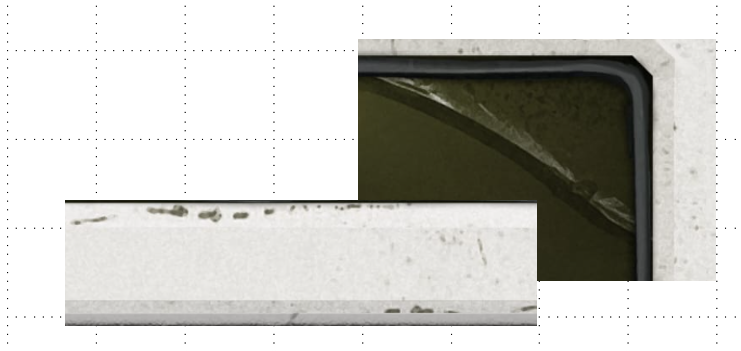
Visually, the interface is designed to support this concept. The screen layout is clean and functional, but it is also intentionally worn and aged. Light scratches, minor signal noise, uneven illumination, and small design imperfections suggest that the hardware has been used extensively and maintained only as much as necessary. Even without explicit story context, the panel’s condition communicates that the game’s setting is not optimistic or pristine—it leans clearly dystopian.
That said, the tone is not relentlessly grim. While the setting is built around control, surveillance, and corporate ownership of personal data, humor is still an essential element of the game’s identity. The contrast is intentional: a strict system creates space for sharper character moments, dry observations, and situational comedy—especially when players start pushing against interfaces that were not designed for empathy.
I’m intentionally not revealing too much of the plot at this stage, but these consoles are a good example of how we approach storytelling: we let the world speak through its everyday tools. In the demo planned for Fall 2026, players will interact with these panels repeatedly, so they need to be readable, consistent, and believable—while also reinforcing the game’s themes every time the screen lights up.